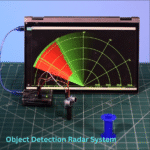
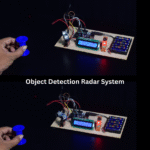


Arduino radar style scanning ultrasonic sensor Arduino object detection radar 0-180°

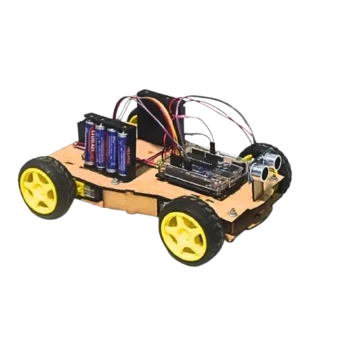
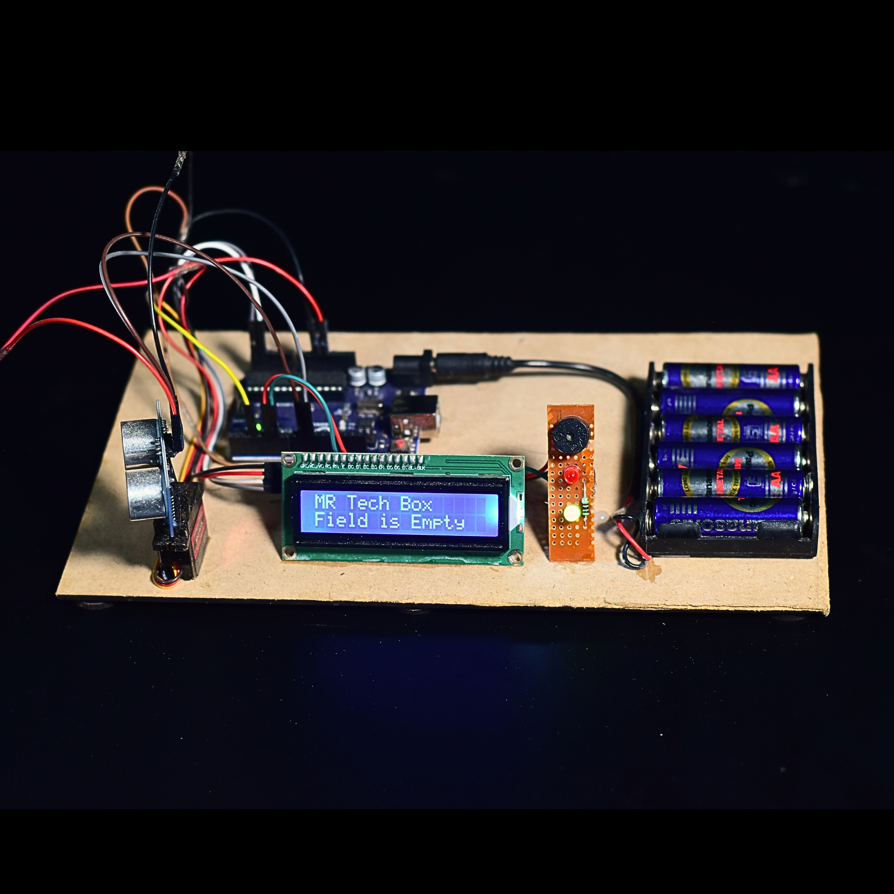
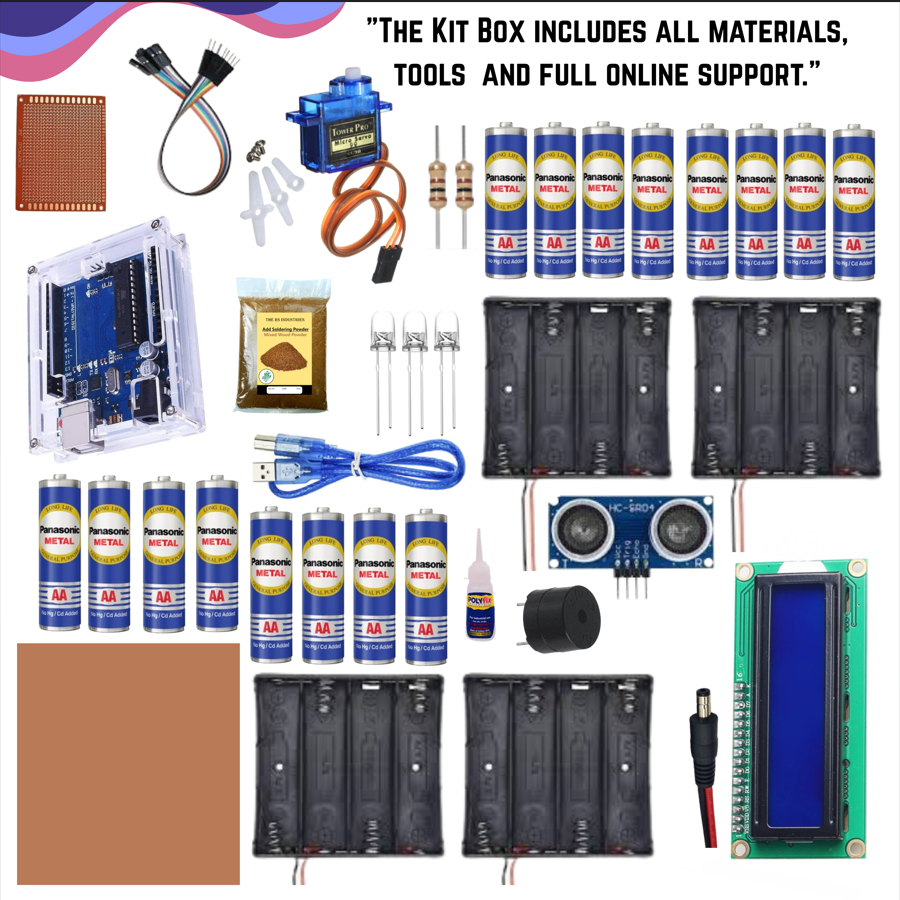
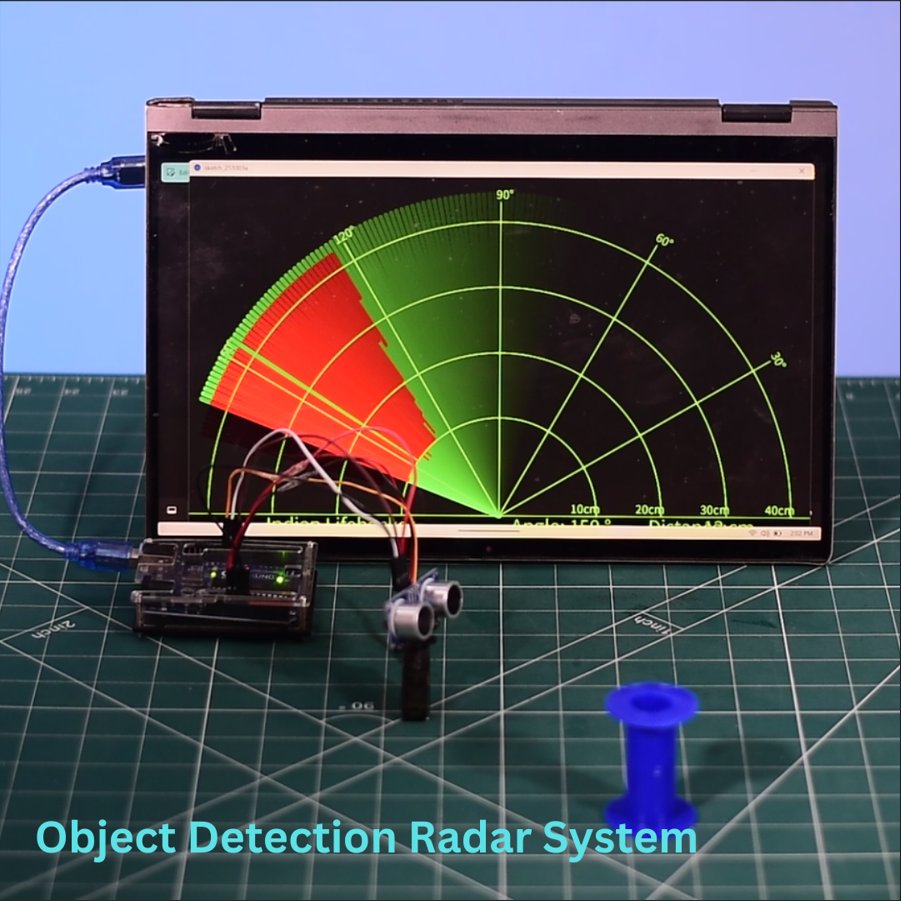
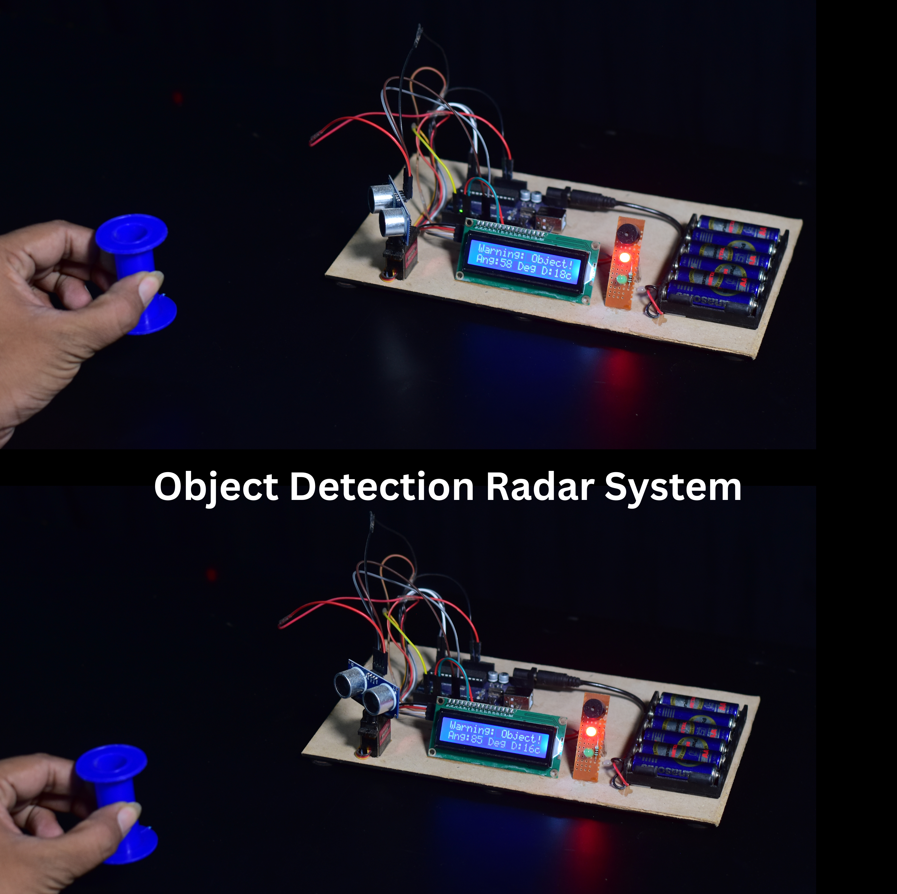
This project is based on an Object Detection Radar System which uses an Ultrasonic Sensor mounted on a Servo Motor controlled by an Arduino Uno. The servo motor continuously rotates from 0° to 180° to scan the surroundings, similar to a radar system. When any object comes within the sensing range (40 cm), the ultrasonic sensor detects it, and the servo motor immediately stops at that specific angle. The system then displays the detected object’s distance and angle on the I2C Display.
₹4,499.00 Original price was: ₹4,499.00.₹3,499.00Current price is: ₹3,499.00.
This project implements a compact object‐detection radar system using the Arduino Uno platform, an ultrasonic distance sensor, a servo motor and an I²C display. The ultrasonic sensor is mounted on the servo shaft and continuously sweeps through an angular range (0° to 180°) to scan the environment, similar to how a radar antenna sweeps its beam. At each angular step, the sensor emits an ultrasonic pulse and measures the return echo time to compute the distance to any object in the path.
When an object falls within a pre‐set sensing range (for example, 40 cm), the servo motion immediately stops at the current angle. The system then captures the angle of detection and the measured distance, and displays this information in real time on an I²C‐connected LCD (or OLED) display. Thus, the user can see both how far the object is and at what angle relative to the scanning baseline it was detected.
The scanning mechanism and the display feedback together give the impression of a miniature radar: the servo acts as the rotating beam, the ultrasonic sensor as the “radar pulse emitter/receiver,” and the I²C display as the output unit providing relevant data. The system is useful in obstacle detection, robotics, security or automation tasks where spatial awareness is required within a short range.
| 5 |
|
0 |
| 4 |
|
0 |
| 3 |
|
0 |
| 2 |
|
0 |
| 1 |
|
0 |
- 8 Years+ Kids
- Arduino Bluetooth Controlled Car
- Arduino Projects for Beginners
- Arduino Security System
- Arduino Servo Door Lock
- Arduino Servo Motor Project
- Automatic Dustbin Project
- Automation Learning Kit
- Beginner Robotics Project
- Best Electrical Project For Final Years
- DIY Robotics Kit
- eco friendly material science project
- Electrical Project
- Electricity kit
- Free Energy Based Inspire Award DIY Science Project
- Free Energy Project
- Generate Electricity By Vegetable Waste /Inspire Awrad Project Kit
- Generate Electricity by Waste Materials/Inspire Award Project Kit Box/Generate Electricity by Plastic and Pollurion Conword to Ink/Electricity from Garbage Project
- Generate Electricity by Waste Materials | High Power Electricity Generator
- Home Security Using Arduino
- Hygiene Based Smart Bin
- Inspire Award Project
- Inspire Award Project kit
- IoT Based Access Control
- IoT Smart Dustbin
- problems faced by military
- Problem Solving Project Idea For Indian Army/Inspire Award Project kit
- project Kit
- Rain Proof Stadium Project / Inspire Award project / Best Electrical Project For Final Years
- RC522 RFID Module Project
- RFID Card Reader Arduino
- Robotic Science Kit 101+ projects 134 Parts
- Safety for wild Animal Project kit/ Best Inspire Award Project Kit
- School Science Project
- science exhibition project
- Science Project Kit
- Smart Door Lock System
- Smart Dustbin for Home and Public Places
- Smart Dustbin using Arduino
- smart speed breaker project
- solar tracker project without arduino
- solar tracker system project
- speed breaker project for school
- Touchless Smart Dustbin
- Waste Management System
Related Products
Introduction: We have developed this project based on India’s Chandrayaan mission. This project is a part of a professional and technical campaign showcasing India’s presence in international space exploration. In this project, we have created a model based on the fundamental concepts of the Chandrayaan mission.
In This Project Our Purpose is for showing how we can protect our forest , In This Project we show a device that device can listen gun sound and activate the sound alarm , this device is amazing , when we use in our forest this device then if any one come for huntering , when we use gun for killing animals then that device capcher the gun sound and transfer the signal to near forest department and there are available receiver so alarm start in forest department so there everyone understand someone enter to forest for huntering animal and he run for stop huntering , this is best device for stop huntering
The Cow Drone Safety system is a cutting-edge technology designed to improve the safety and well-being of cattle on farms. By utilizing drones equipped with advanced sensors and monitoring capabilities, this system aims to revolutionize the way farmers manage their livestock. In this project, we will explore the design, functionality, and potential benefits of the Cow Drone Safety system.
Generate Electricity By Waste Materials
Generate Electricity By Plastic
Free Energy Generate Project
electricity from garbage
Waste Materials By Generate Electricity
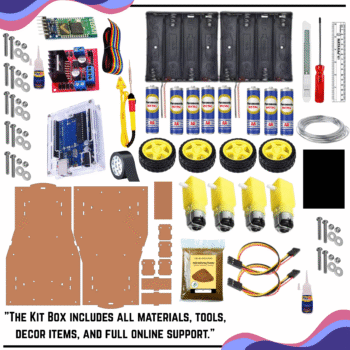
In this project kit box we will give you all components and parts , Extra decoration materials , How to make full step by step video and 3D circuit diagram , Reading pages , Synopsis file , Online training access There will be more wires around the field wall , The direction from which the animals are entering the fields, then on coming in touch with the wire which is around, the alarm will start sounding from the same direction, so that the animal will feel that someone is coming and he will run away due to which the farmer is not in the fields. There will be safety and there will be no harm to the farms and animals. So If farmer go to out side of field then his crop save by animal Best Part Of This Project , It’s System Making Cost Very Low Any Farmer Can buy or Make Himself And Use In Field .
1. Introduction: In today’s world, the growing concern for environmental sustainability has led to the development of renewable energy solutions. Electric vehicles (EVs) have gained popularity as an eco-friendly alternative to traditional gasoline-powered cars. However, one of the challenges faced by EV owners is the limited range due to battery constraints. To address this issue, we have developed a groundbreaking project – a solar-powered wireless charging system that can provide emergency charging to electric vehicles using a remote-controlled (RC) robotic car.
Solar Street Light School Science Project
Solar Street Light Project
LDR Solar Street Light
Automatic On/Off Solar Street Light
Automatic Solar Street Light School Science Project
Welcome to our Smart Inverter Project tutorial! In this video, we’ll show you how to build a DIY inverter that provides an automatic power backup solution for your home. If you’re looking for a continuous power supply during outages, this inverter with battery storage will keep your lights on even when the main power goes out.
This project involves creating a smart inverter circuit that can seamlessly switch from AC power to a 12V DC battery when the electricity supply is interrupted. Not only does it ensure uninterrupted power to your 230V AC appliances, but it also recharges the battery when the main power is available.
In this detailed how-to guide, we cover everything from the basic components needed to the step-by-step assembly and testing of the inverter. Plus, we’ll discuss how this inverter system can be adapted for use in transmission lines, ensuring a reliable power supply to cities from substations, even if the main transmission line fails temporarily.
What You’ll Learn in This Video:
Inverter Basics: Understand how an inverter works and the role of battery storage in providing continuous power.
Step-by-Step Construction: Follow our easy instructions to build your own inverter circuit with a 12V DC battery backup.
Automatic Switching: Learn how the inverter automatically switches to battery power during outages and back to AC power when available.
Practical Applications: Discover how this smart inverter system can be used in transmission lines to maintain city power supply during disruptions.
The Automatic Staircase Lighting System is an Arduino-based project that uses IR sensors to detect movement and control LED lights automatically. When a person steps on the first or last stair, the lights turn on and switch off after crossing, saving energy and enhancing safety. Ideal for homes, malls, parks, and public places.
IR Sensor: The IR sensor is used to detect the presence of a vehicle. When a vehicle enters the range of the sensor, it detects its presence. Relay Module: The relay module is used to control the system. Once the IR sensor detects a vehicle, it sends a signal to the relay module, which in turn activates the LED bulb and alarm. LED Bulb: The LED bulb is used to indicate the presence of a vehicle coming from the opposite side. When a vehicle is detected by the IR sensor, the LED bulb on the other side turns on, alerting drivers. Alarm: The alarm sounds to provide a warning of the vehicle’s approach, ensuring further attention and safety. Wiring and Connections:
Working Principle: When a vehicle enters the range of the IR sensor, the sensor detects its presence. The IR sensor sends a signal to the relay module. The relay module then activates the LED bulb and alarm on the opposite side. The alarm and LED bulb warn the drivers that a vehicle is approaching.
Objectives: Enhance road safety by alerting drivers about vehicles approaching from the opposite side. Prevent traffic accidents, especially in areas with limited visibility. Create a simple and cost-effective vehicle detection system for traffic monitoring.
Expected Outcomes: Early warning system for approaching vehicles, giving drivers more time to react. Improved awareness and timely responses from drivers to avoid accidents. Efficient use of sensors and alarms to ensure smooth traffic flow and safety.
Applications: Safety alert system on narrow roads or blind spots. Traffic control at signal points or crossing areas. Monitoring vehicles in industrial areas or warehouses where safety is critical.
Future Improvements: Use of advanced sensors (e.g., ultrasonic) for better accuracy. Integration with traffic signal systems for automated control. Solar-powered systems for cost-effective outdoor applications.
This Arduino RFID Access Control System uses an RC522 module to read card UIDs, an I2C LCD to display messages, and a servo motor to open or close the door automatically. A blue LED indicates card detection. It’s a simple, low-cost security project ideal for beginners in IoT and electronics.
In this project, you will see a 4-way traffic light control system with an advanced safety feature – traffic spikes/barriers. When the signal is red, the spikes stay up to stop vehicles from breaking rules. If anyone tries to cross, their vehicle can get a flat tyre. 🚗❌ When the light turns green, the spikes go down, and vehicles can move safely.


Reviews
There are no reviews yet.