




Safety Gadgets For Students/Inspire Award Project

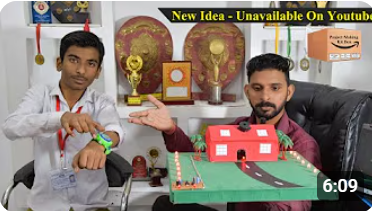
This Idea For Safety Gadgets for Students , If any student have problem and he want to inform his home then he press his watch switch and his home alert alarm start , This is best Innovative idea and easily making base if any students make this project for his science Exhibition , This is Best inspire award project idea and This Idea not available on YouTube , So This is Unavailable Idea On YouTube For Inspire Award Project
Original price was: ₹2,999.00.₹2,200.00Current price is: ₹2,200.00.
In This Project we show a watch with alert signal transmit system with when student face a problem that time he can press the watch alert button and signal transmit to receiver and receiver start Red alert LED bulb to house and family understand his boy have a problem this is amazing idea for student safety.
Related Products



In this video, I demonstrate how to create a floating house using ACC blocks (Autoclaved Aerated Concrete blocks) and a cardboard house. I built the base of the house with ACC blocks, which are lightweight and float on water. When placed in a water tank, the house’s height automatically rises with the water level, preventing it from sinking. This project shows how real-life houses can be designed to stay afloat during heavy rainfall or floods, offering a solution for disaster management in flood-prone areas. The idea behind this floating house concept is to build homes that automatically adjust their height based on the rising water levels, ensuring that they do not get submerged during extreme weather conditions.
This floating house project is a great idea for those interested in science experiments, civil engineering projects, or innovative disaster management solutions. Whether you’re a student, a science enthusiast, or someone looking for unique school projects, this video will help you understand the concept of a floating house and its potential use in real life. Watch the full video to see how you can make this project at home and learn about flood-resistant house designs.
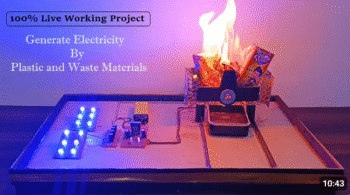
Generate Electricity By Waste Materials
Generate Electricity By Plastic
Free Energy Generate Project
electricity from garbage
Waste Materials By Generate Electricity
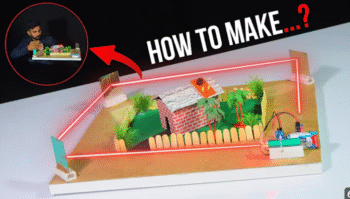
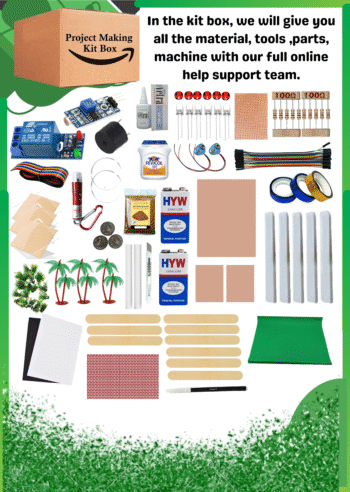
How It Works: Laser Beam Setup: A laser torch emits a beam that travels across the area by reflecting off three strategically placed mirrors (glasses). This configuration creates a continuous laser barrier around the perimeter of a model house or any area you wish to secure.
LDR Detection: The laser beam ultimately hits an LDR module, which is sensitive to light. As long as the laser beam is unbroken and falls on the LDR, the system remains in a passive state, with no alarm triggered.
Relay and Buzzer Activation: The LDR is connected to a single-channel relay module that controls a 9V buzzer. If the laser beam is interrupted, the LDR detects a change in light intensity, signaling the relay to activate the buzzer. This results in an audible alarm that warns you of the potential intrusion.
Unauthorized Entry Alert: The alarm is designed to activate whenever there is an obstruction in the laser path, such as someone entering the secured area without permission. This feature provides a simple yet effective means of safeguarding your space.
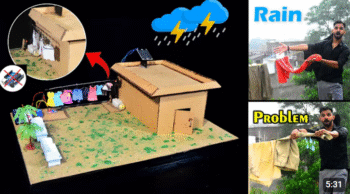
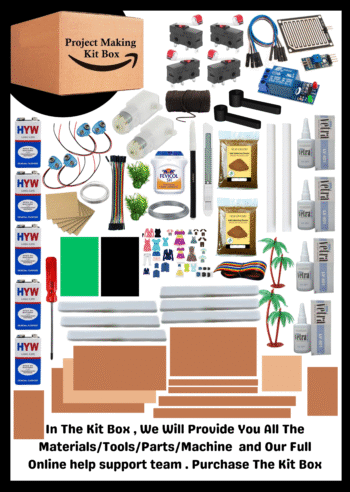
Learn how to build an automatic clothes drying system that responds to rain! In this project, we connect a rain-sensing module to a relay module, which activates a motor to move clothes indoors when it starts raining and back out when the rain stops. Perfect for keeping your laundry safe from unexpected showers. Ideal for DIY enthusiasts, smart home projects, and anyone looking to automate daily chores. Watch now to see how easily you can set up this rain-activated clothes drying system.

Introduction: We have developed this project based on India’s Chandrayaan mission. This project is a part of a professional and technical campaign showcasing India’s presence in international space exploration. In this project, we have created a model based on the fundamental concepts of the Chandrayaan mission.

The name of this project is safety helmet. Mainly work of this project is safety of a rider. We make a connection between bike and helmet by using the sensors. When rider will wear the helmet then our bike start. If the rider will not wear the helmet then bike will not start. We use the indication system in the helmet also. Indication system will show you wear the helmet properly or not. So it’s good for safety purpose and we safe it from thief also. Because without helmet bike will not start.
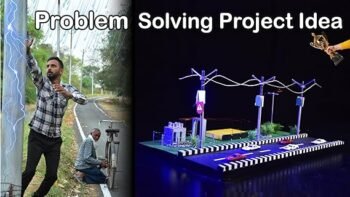
The Problem: Electrical poles, being integral components of power distribution networks, are susceptible to various faults, including short circuits. These faults pose significant dangers to both nearby individuals and the infrastructure itself. However, identifying when a pole is experiencing a fault, especially during adverse weather conditions like rain, can be challenging.
The Solution: Our project introduces a visual indicator system designed to promptly notify observers when a fault occurs in an electrical pole. This system consists of a small strip affixed to the pole, divided into two distinct colors: green and red. During normal operating conditions, when no fault is present, the strip remains green, indicating that the pole is functioning safely. However, when a fault such as a short circuit occurs, the strip promptly changes its color from green to red, si
How it Works: The indicator strip is equipped with sensors capable of detecting abnormal electrical activity, such as an increase in current flow due to a short circuit. Upon detecting such an anomaly, the sensor triggers the color change mechanism, causing the strip to transition from green to red. This visual change serves as an immediate warning sign to anyone in the vicinity that the pole is experiencing a fault and should be avoided.
Benefits: Enhanced Safety: By providing a clear visual indication of faults, the system helps prevent accidents and injuries caused by inadvertent contact with electrified poles. Timely Response: Prompt identification of faults enables swift corrective action, minimizing downtime and potential damage to the electrical infrastructure. User-Friendly: The simplicity of the color-changing indicator strip ensures that it is easily understandable by individuals of all backgrounds and levels of expert
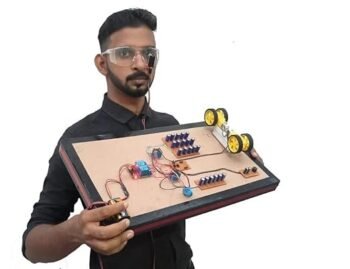
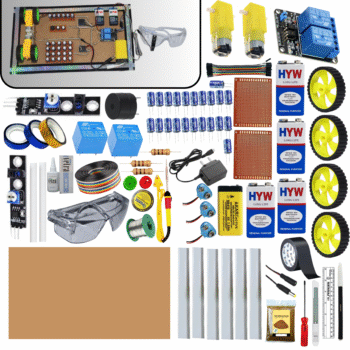
Eyes Blink Sensor: An eyes blink sensor is a device or sensor that detects and monitors the blinking of a person’s eyes. It can be used for various purposes, such as in medical applications, research studies, or even as a personal alert system. When the sensor detects that the person’s eyes are closed or blinking, it triggers a specific action or event, such as sounding an alarm.
Audible Alarm: The sensor is equipped with a sound-generating mechanism that produces an audible alarm when it detects closed or blinking eyes. This alarm sound can be a beep, chime, or any other distinct sound that alerts the user or others in the vicinity.
Safety Applications: The alarm functionality can be particularly useful in safety-critical environments, such as monitoring drivers for signs of drowsiness, operators of heavy machinery, or individuals performing tasks that require sustained focus and attention.
this project use materials name – Glass , Ir Sensor , Pcv Plate , Alarm , 1K resostor , 9v Cap , 9v Battery , Jumper Wire , Glue Road , Soldering Powder , Screwdriver
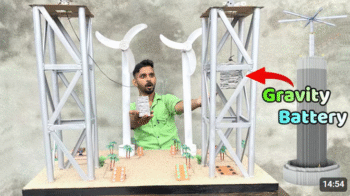
Renewable Energy Storage Solution: Gravity battery is a sustainable energy storage solution for, designed to store excess energy generated from renewable sources like solar or wind.
Low Environmental Impact: Environmentally friendly as it avoids hazardous materials and relies on gravitational potential energy, reducing the ecological footprint. Scalable and Modular Design:
Gravity batteries have longer lifecycles compared to conventional batteries, leading to reduced replacement and maintenance costs.

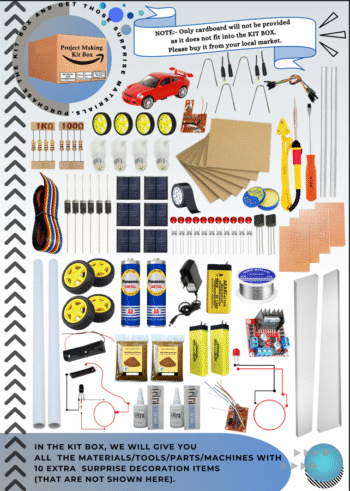
1. Introduction: In today’s world, the growing concern for environmental sustainability has led to the development of renewable energy solutions. Electric vehicles (EVs) have gained popularity as an eco-friendly alternative to traditional gasoline-powered cars. However, one of the challenges faced by EV owners is the limited range due to battery constraints. To address this issue, we have developed a groundbreaking project – a solar-powered wireless charging system that can provide emergency charging to electric vehicles using a remote-controlled (RC) robotic car.
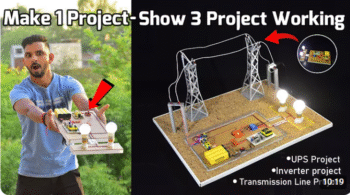
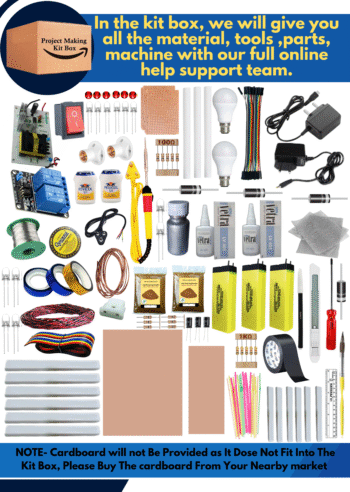
Welcome to our Smart Inverter Project tutorial! In this video, we’ll show you how to build a DIY inverter that provides an automatic power backup solution for your home. If you’re looking for a continuous power supply during outages, this inverter with battery storage will keep your lights on even when the main power goes out.
This project involves creating a smart inverter circuit that can seamlessly switch from AC power to a 12V DC battery when the electricity supply is interrupted. Not only does it ensure uninterrupted power to your 230V AC appliances, but it also recharges the battery when the main power is available.
In this detailed how-to guide, we cover everything from the basic components needed to the step-by-step assembly and testing of the inverter. Plus, we’ll discuss how this inverter system can be adapted for use in transmission lines, ensuring a reliable power supply to cities from substations, even if the main transmission line fails temporarily.
What You’ll Learn in This Video:
Inverter Basics: Understand how an inverter works and the role of battery storage in providing continuous power.
Step-by-Step Construction: Follow our easy instructions to build your own inverter circuit with a 12V DC battery backup.
Automatic Switching: Learn how the inverter automatically switches to battery power during outages and back to AC power when available.
Practical Applications: Discover how this smart inverter system can be used in transmission lines to maintain city power supply during disruptions.
Reviews
There are no reviews yet.